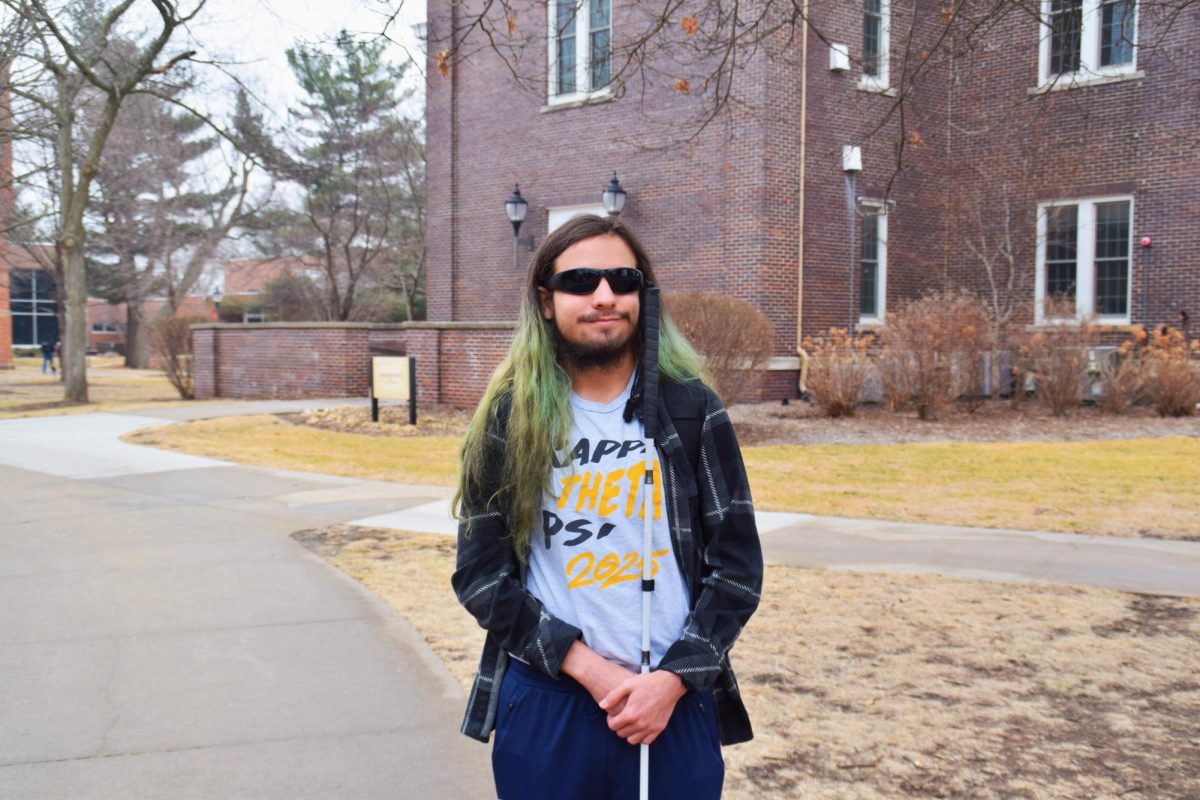
Navigating campus life and the trials of being a young adult often come with many challenges, but for one Simpson College student, these challenges come with an added layer: navigating campus and college life without sight.
For Nebraska native and sophomore Riley Tuzzio, they never imagined a life facing such uncertainty; in fact, over four years ago, they never imagined they would be declared legally blind.
“It’s been one hell of an emotional rollercoaster,” Tuzzio said.
On Feb. 10, 2022, Tuzzio woke up with one eye in pain, blurry vision and extreme sensitivity to light. He was told it was a viral infection and steroids and eyedrops would relieve any concerns. However, every morning, he woke up to his vision getting worse and worse.
Eventually, the symptoms started in the other eye, and Tuzzio was sent to the University of Nebraska Medical Center. There he was, poked and prodded for months, receiving no answers.
“We didn’t know what was happening to me,” Tuzzio said. “It took almost a year to figure it out. There were so many medical tests, so many vials of blood drawn and they even took my spinal fluid at one point.”
By May 2022, their vision had declined to 20/30. Today, it measures 20/1600; a level of vision loss where they must be 20 feet away to see what someone with standard eyesight could see from 1600 feet.
Tuzzio missed a month of school while he tried to grasp what was happening to him. He eventually went back, but since he didn’t have a diagnosis, he wasn’t granted full access to resources. He was forced, with little assistance, to relearn the things he had been doing for 15 years.
They wouldn’t get an official diagnosis until Jan. 2023: retinal dystrophy, a genetic condition Tuzzio was unknowingly born with, which laid dormant for 15 years. Tuzzio believed a bad case of COVID-19 was the underlying stressor that led to the gene “turning on.”
“It was all just a mix of fear and confusion because what the fuck is happening?” Tuzzio said. “I was in despair, crying in my room. I mean, I wasn’t even 16 at the time, so I think it was a part of that teenage self-esteem of like this one thing is happening to me, this is gonna be my life, and in most other situations, it probably isn’t, it’s just gonna be that small thing and I’m overreacting. But this has definitely become my life.”
Tuzzio was depleted and depressed for the majority of the remaining semesters of his high school career. This mental state stemmed not only from the diagnosis, but also because of the opportunities it took away from him.
Prior to the diagnosis, he was on track to earn his associate’s degree in cybersecurity before graduating high school, and get a jump-start on the career he desired. He had to throw away those degrees and career dreams, leaving him lost in his search for a future.
Eventually, Tuzzio’s literal dreams even began to blur.
“Before the official diagnosis, I had had this subconscious recognition that this is going to be permanent,” Tuzzio said. “In May of that year, I remember I was no longer dreaming in clear vision.”
Tuzzio, who was months away from getting his driver’s license and being granted the freedom all young teenagers feel when they smile for their ID photo, would never get the opportunity. He isolated himself to the point where he needed Vitamin D supplements to make up for the lack of sunlight he wasn’t receiving.
A twin sibling helped him walk the difficult paths of high school, and Tuzzio faced the challenge head-on. However, he would’ve never predicted the students at both his high school and now at Simpson would accuse him of lying about his diagnosis.
“Kids questioning my blindness started literally right after,” Tuzzio said. “It was demoralizing because it’s like, I’m going through this, I don’t even know your name, I’ve never heard of you before and you’re saying this. How do you have any information about me?”
Tuzzio never wants to confront the individuals who question them because those closest to them know the truth, which is what matters most.
The rumors carrying onto Simpson’s campus didn’t surprise him; however, he was shocked to learn within just the first weeks of his first year, kids were using the anonymous app YikYak to poke fun at his situation.
“An upperclassman mentioned to me that someone was commenting on this app I had never heard of, and I ended up getting it just to monitor the situation,” Tuzzio said. “Eventually, there would be the very occasional in-person comments I would hear, and I was just like, ‘wow.’ And I, again, wouldn’t really challenge it because I don’t want to make this a bigger deal.”
Senior Kaleb Harvey, one of Tuzzio’s peers, doesn’t have YikYak, but knows all too well the toxic purpose the app holds on Simpson’s campus.
“People often gossip about others, especially when it’s hard to trace it back to them,” Harvey said. “The targets of this are always those who stick out, and Riley doesn’t blend in with the faceless masses of students. So they become an easy target for gossip, unfortunately. There will always be some good and some bad with platforms like YikYak. I just hope more people choose to use it for good.”
In high school, it took Tuzzio sharing his story with his school’s student media for him to see a positive change in how people treated him.
They described one of the toughest obstacles they had to overcome was spatial awareness, which people with vision often take for granted
Anyone who attended high school knows how loud the hallways get during passing periods, and has more than likely been annoyed by the groups who stand in the middle, expecting you to go around them.
Now, imagine having only sound to rely on. In these conditions, with those groups, it was beyond challenging for Tuzzio to simply make it to his next class on time.
“After I had mentioned this in the magazine, I noticed the group that stood there every day stopped,” Tuzzio said. “A girl later on actually admitted to me that it was her friend group and that after reading my story, they decided to stop doing that.”
Tuzzio doesn’t expect people to give him explicit support, but he does want their open-mindedness and awareness of his situation. He also wants people to know he will answer any questions they may have.
“If you don’t ask questions, you can’t come to an understanding of anything, and you are just forming those assumptions and judgments,” Tuzzio said. “And even outside of my situation, that can just be harmful in general for your interactions with the world.”
Tuzzio said he always carries the documents signed by his ophthalmologist in his backpack, which state he is legally blind, waiting for the day anyone may have questions or speculations to ask him.

They have never been personally asked face-to-face throughout their four years of being blind.
“People instead just choose to say ‘yeah, you’re not (blind),’ and that’s the most annoying part,” Tuzzio said.
He understands people may be worried about asking the wrong questions or accidentally being offensive. Still, he wants everyone to know he is an open book and that they have nothing to worry about.
For Tuzzio’s high school career, he found his footing towards the end and began to grasp his purpose again. He decided it would be wise for him to go to college and invest his time and energy into being productive.
He chose to leave the comfort of his home, 130 miles away, to pursue a double major in social justice and psychology with a minor in philosophy at Simpson because it met all his priorities and offered the best accommodations.
Harvey states Tuzzio is a chaotic, outgoing and reliable soul who is always surrounded by fun. He also wants people never to overlook the old adage: “Don’t judge a book by its cover.”
“That really is Riley in a nutshell,” Harvey said. “A disability of any degree or any spectrum doesn’t mean a person isn’t fun to be around, nor are they dependent on other people. It doesn’t take eyes to write an incredible paper or play video games with friends. All it takes is effort and enough compassion to try.”
Tuzzio is currently a member of Kappa Theta Psi, serving as the Master of Obligations. He is also a Writing Center consultant and a peer academic mentor, and despite any negative comments online, he is thoroughly enjoying his time at Simpson.