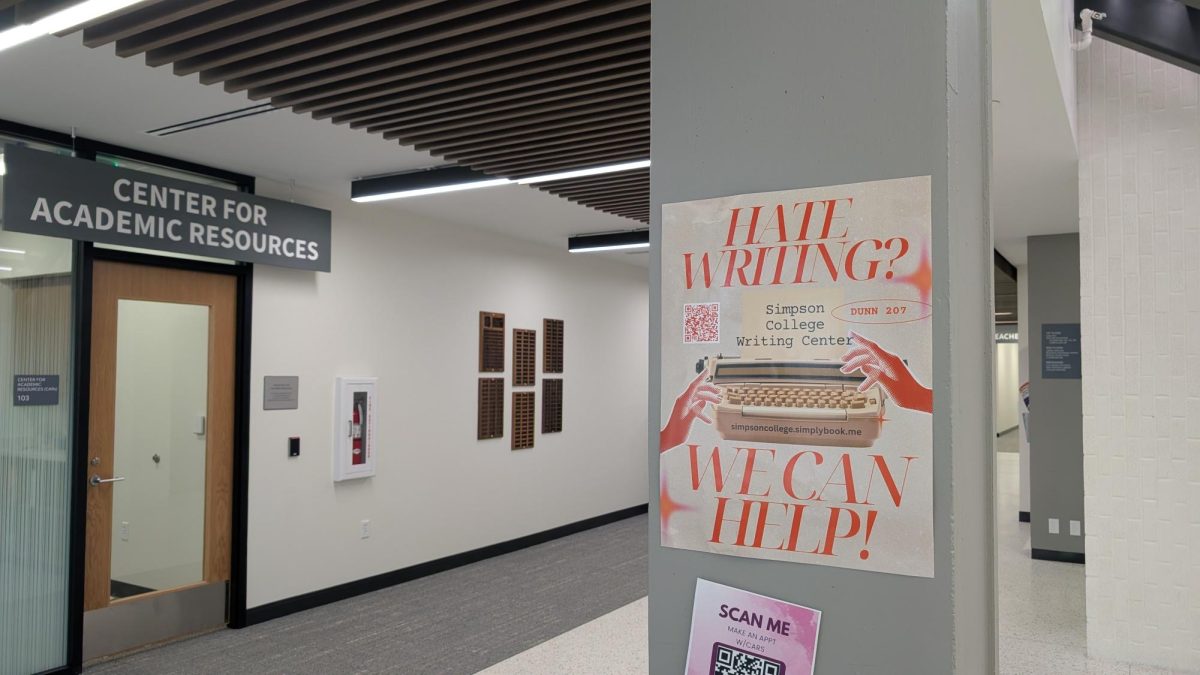
Just inside Dunn Library at Simpson College, on the first and second floors, are the people and resources of the Center for Academic Resources (CARS).
The support team consists of three branches: academic coaching with the Peer Academic Coaches (PACs) and Peer Academic Leaders (PALs), the Writing Center and its consultants and Student Accessibility Services (SAS).
While the structure is institutionally guided, many of its services are focused on peer-led, student-to-student support.
In academic coaching, both PACs and PALs are committed to encouraging their study tips for their designated topics. The PACs’ focus is to be an accountability partner, a study partner and an advice resource for peer and general academic stress. The PALs’ focus is one-on-one coaching for specific classes.
Ranging from accounting, math and biology tutoring, to music and Spanish coaching, the PALs are trained to see a wide variety of students each week.
Junior health and exercise science major, and PAL, Joseph Wollum, spoke about his experience as a coach for biology 111 and anatomy. He explained his approach to helping different students.
“I like to ask right at the beginning if it’s the first time I meet them, how they learn best,” Wollum said. “If they’re more like a visual person, then we can draw a lot of stuff out, or if they’re more of a recall person and learn from the notes, we can do that or other activities or practice questions.”
Wollum described common learning trends he experiences with students. He outlined how most of what he teaches includes proper study methods and what to do after lectures, along with the class content.
“Some students, after a lecture, they just don’t go back and review the notes and they lose it all in a week, and then it’s like a whole week’s worth of lecture we’re having to go over it again and learn and remember how to study,” Wollum said.
Wollum also shared his work with routine clients. He revealed he sees the same seven to eight people every week, and balancing the peer-to-peer dynamic while maintaining the professional coaching goal is important to all academic coaches.
“We never talk about coaching outside of when we’re in it,” Wollum said. “If I see them on campus, I just talk to them like another peer of mine … I never bring up coaching outside of the library.”
The Writing Center shared the same perspective. Focused specifically on student papers at any stage, projects, presentations, speeches or any general student communication assignments, the Writing Center highlights the necessity of maintaining a balanced relationship between consultants and clients.
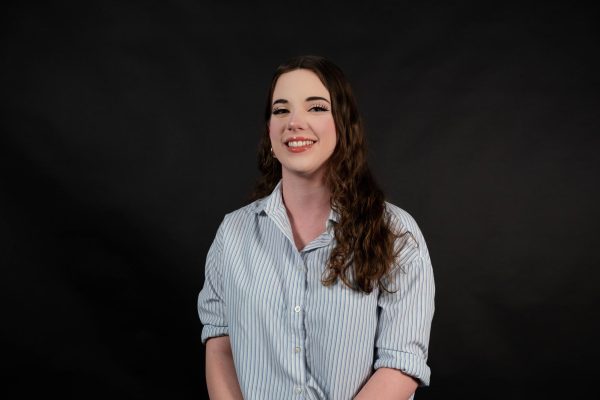
Junior political science and English major, Peyton Robertson, has worked at the Writing Center for almost two years. She explained what this dynamic is like.
“Once you enter in here, even if we’re friends, we’re here to work on your paper,” Robertson said. “Approaching all the papers and all the people with the same professional approach is really important.”
Jen McGovern, the Writing Center Director for the past two years, echoed this sentiment. She shared the Writing Center’s mission of outreach.
“Students of all levels, no matter whether they feel like they’re doing really well or they’re struggling, should feel comfortable coming in,” McGovern said. “Some of my best students are the ones who recognize the importance of peer review.”
McGovern explained that a common misunderstanding about the Writing Center is that it is meant only for serious help or for students who are bad writers. McGovern emphasized the falsity of this assumption.
“Everybody needs it,” McGovern said. “No matter what it is you need read, somebody should work with you, and it’ll be helpful.”
Robertson explained her experience bridging the gap in between understanding students and the Writing Center’s goals. She detailed how the center is there for all stages of the writing process and is not just a quick one-stop revision and grammar-check station.
The consultant also outlined her perspective on what the Writing Center ultimately accomplishes for students.
“I think we are really good at just helping students give themselves the confidence they need or didn’t know they had,” Robertson said. “What we can provide is, yes, assistance in making it better where we can, but also reassuring them that they’re on the right path.”
Karen Lynch, the director of Student Accessibility Services (SAS), shared this same outlook on pairing assistance with reassurance. She explained the importance of helping students understand that they are not alone.
“We feel like our job is at the most basic level accommodations, but really, we see ourselves as a student support office,” Lynch said. “So, if you walk away with your accommodations and don’t feel they’re being implemented, we want to know about it. We want to advocate with you.”
Lynch also emphasized that SAS does not merely provide the accommodations and ask students to do all the work on their own. She shared the office’s commitment to well-rounded support.
“Our primary goal as an office –our mission, is self-advocacy; is to support student self-advocacy,” Lynch said.
Highlighting the significance of student accessibility, Lynch noted that schools that focus solely on compliance rates must meet the legal requirements for representation and resources as outlined by standards such as the Americans with Disabilities Act (ADA). She shared the importance of the shift from this required perspective to a more accessible, open campus culture.
“We’re trying to infuse a disability norm culture on campus. We serve about 20% of the Simpson’s population in my office, and that is almost equal to the rate the CDC says young adults identify as disabled in the general population,” Lynch said. “So, we’re finally doing something that is allowing students to see that it’s safe to disclose and it’s safe to tell a professor, ‘I need these things,’ and they know they’ll be supported through our office if there is a problem.”
Across all three sections of CARS, the same expression is revealed: student agency, peer-to-peer assistance and an emphasis that students are not alone.
Whether through academic coaching, Writing Center consulting or accessibility services, Simpson students have access to this support system focused on their individualized needs.