
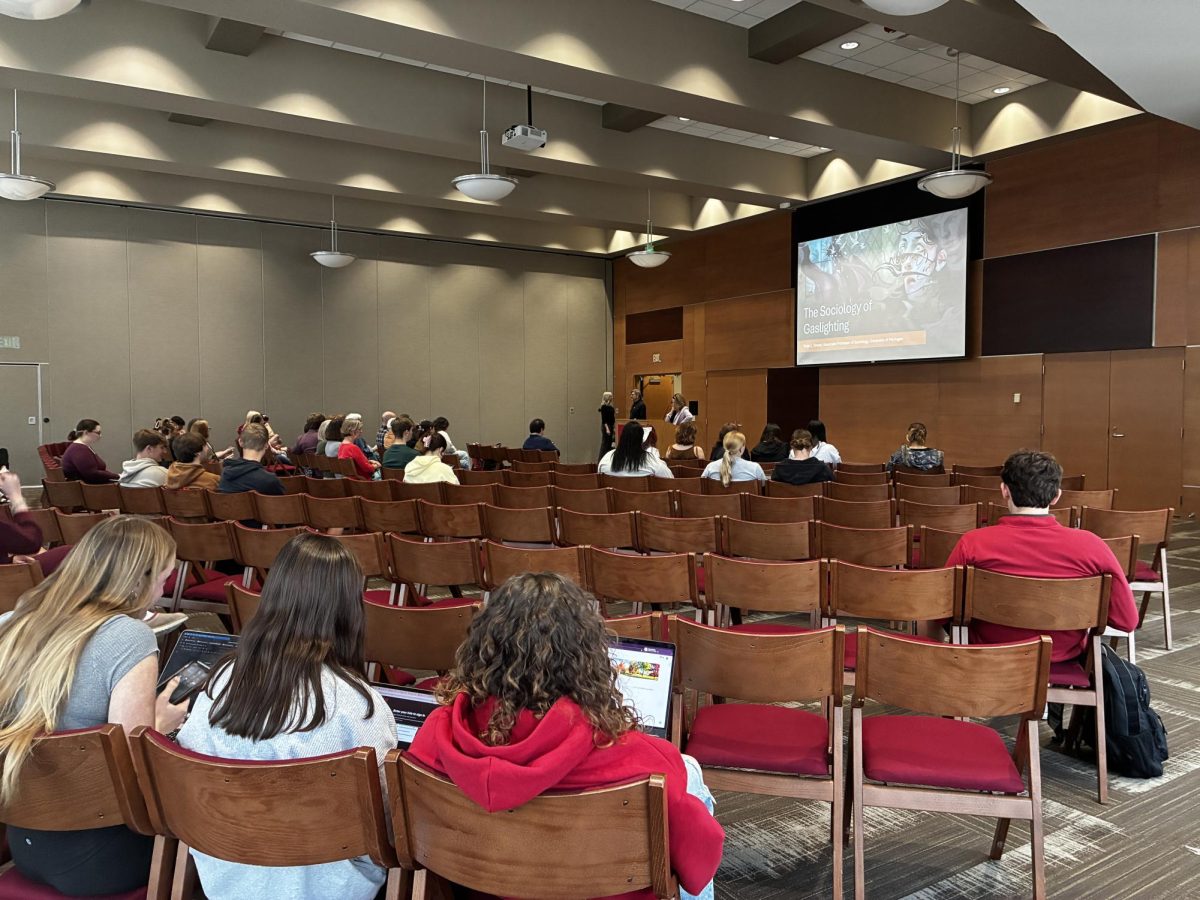
On March 25, about 70 individuals, consisting of students, staff and community members, attended a lecture about the sociology of gaslighting given by Paige Sweet, an associate professor of sociology at the University of Michigan. This lecture was a part of the 37th Women in America Lecture, which was organized by Simpson to celebrate Women’s History Month.
Sweet’s research revolved around the victims of gender-based violence and how they have navigated the systems that may be either beneficial or harmful to them. She has worked with several victims in her studies and has also written a book titled “The Politics of Surviving: How Women Navigate Domestic Violence and Its Aftermath.” Currently, she is working on another book about gaslighting.
Gaslighting is a common term referring to a form of toxic mental manipulation. According to Sweet, it was Harry Webster’s 2022 Word of the Year, and Google saw a 2000% increase in research on the term from 2021 to 2022.
“Gaslighting can really mess with your memory of events, and you can question if you’re really a victim, and you may doubt yourself,” Sweet said.
In her lecture, Sweet focused on how gaslighting is used in romantic relationships and can specifically impact females. Throughout her talk, she had several slides containing quotes from victims stating how they felt when they were being gaslit, and what their partners would do to them.
Sweet said while in these relationships, the victims often described their mental state as foggy, stuck in the Twilight Zone or in a washing machine, and questioning their own actions and thoughts because their partners made them feel “crazy.”
According to Sweet, abusers would hide their partner’s belongings to keep them from leaving the house and proceed to call them careless, and there have also been instances of abusers shoving their partners, claiming they were at fault for being shoved.
Sweet said, however, to view gaslighting as a sociological problem rather than a psychological one; her talk provided a clear definition of gaslighting.
“By sociological problem, I really mean a problem of power and inequality that hinges on structural and historical conditions that are embedded deeply in our social fabric,” Sweet said.
According to Sweet, viewing gaslighting as a sociological problem will help people better understand the cycle of abuse. Sweet also said gaslighting can shape relationships through social conditions and stereotypes.
“Our intimate lives are shaped by power and inequality,” Sweet said.
Sweet mentioned how abusers use gaslighting to have power over their partner, and will use humiliating strategies to gaslight their victims through disorientation, isolation, shame and attack.
Sweet brought up what she called romantic ownership and described it on one of her slides.
“The idea that romantic relationships can/should involve ownership of your partner’s sexuality, affection, intimacy, and social life.,” Sweet said.
Many of the victims said their partners would shame them by attacking their ability as a mother, their sexuality or their body image while isolating them from friends and family.
Paw Moo, a junior majoring in criminal justice and minoring in sociology and human services, attended and provided an opinion on the lecture.
“I honestly find this really interesting,” Moo said. “Especially different forms of gaslighting, there’s just like a way, like someone can control you when it comes to gaslighting, that could be a normal thing, but you don’t see it as a big problem.”
Assistant Professor of Music Jon Arnold, and his wife, Megan Brunning, were also in attendance. They also had their own takeaways from the lecture.
“It was really nice to hear an expert’s explanation of gaslighting,” Brunning said. “She touched on how the term is being used more loosely with its new popularity. So it’s nice to get a really exact definition.”
“I thought it was meaningful and sort of alarming to hear the depth and severity of so many personal experiences,” Arnold added.
Simpson provides free counseling services for students who believe they may be in a toxic relationship. These services can be accessed on the second floor of Kent Campus Center, and emailed at: [email protected].