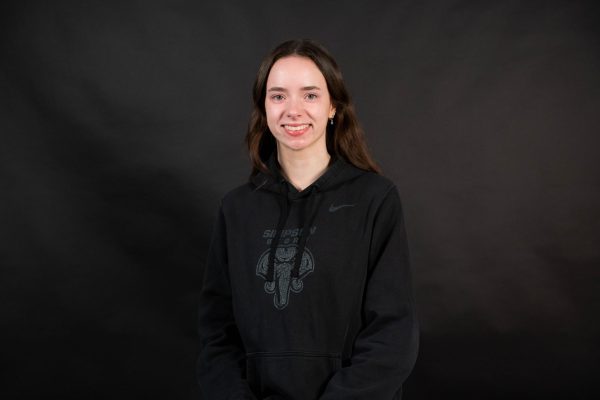

Simpson College senior Emma Tolbert’s year was supposed to be an exciting final chapter to close out her childhood dream of doing college gymnastics. As a health and exercise science major with a minor in coaching, Tolbert spent years building confidence and skills for one last season with her team, and one final chance to compete and finish on her own terms. A month before the season began, everything took a turn.
During the team’s second intrasquad competition of the year, Tolbert was competing in her floor routine. As she was executing her leap pass, a skill she’s completed countless times before, her landing was different. Her shoulder dropped and her knee caved inwards, which is when she knew something was wrong. Tolbert’s knee slipped out of place, and as she hopped off the floor, she already knew what had happened.
“I knew pretty quickly that I tore my ACL”, Tolbert said.
At this moment in time, the pain wasn’t just physical. She realized she was going to have to go through another injury in her senior year.
“I was just kind of like, I can’t do this again,” Tolbert said.
Having had an injury before, the idea of going through another recovery process came with an overwhelming feeling. Tolbert was devastated that her final season might have ended before it even started.
Senior gymnast and Tolbert’s teammate, Sydney Nalette shared her take on the situation.
“I was heartbroken,” Nalette said. “It was really sad because she had worked so hard during preseason, and then it all came to an end.”
For the team, it was hard to watch it happen right in front of them, given the hours and preparation she had put in leading up to that point.
Having support from teammates can help, but it doesn’t make the process any easier. For Tolbert, she found watching from the sidelines difficult, especially when she wanted to be competing alongside the seniors.
“Watching everybody compete, specifically watching the seniors,” Tolbert said, was one of the most difficult parts of the competition season.
It goes beyond just competitions; even the normal day-to-day activities became a challenge. A normal day for Tolbert involved training and lifting, which led to competing on the weekend. Suddenly, she wasn’t able to do any of this.
“Not being able to do anything at all, that’s probably been harder than me not being able to do gymnastics,” Tolbert said.
Recovery from injuries is not just physical, it can also take a mental toll as well. The surgery was more of a challenge than she expected, and balancing a new daily routine didn’t happen overnight. Through time and patience, Tolbert began to find her footing, including taking on a new role within gymnastics.
Instead of stepping aside, she became a leader.
With encouragement from her coaches, Tolbert took on a new role within the team, which has provided a new outlook for her. She began to help coach and became more involved in the team huddles. What started as a way to stay connected with the team turned into something more.
“I became more of like the person girls would come to at meets to calm them down,” Tolbert said.
Being there for teammates helped her take her mind off of not being able to compete. In a competition setting, it was harder not to think about not being out on the floor, this new leadership role helped her stay involved.
Tolbert’s impact on the team wasn’t overlooked. Nalette described her as an incredible teammate.
“(She’s) someone you can rely on if you’re struggling in the gym or even outside the gym,” Nalette said.
Tolbert’s positive attitude stood out the most to Nalette.
“She was always happy, always there for the team, always cheering everyone on even though I know it was really hard for her.” Nalette said.
Head coach Emily Barret Payne witnessed the same growth.
“She did a great job stepping into more of an encouraging role,” Payne said. “She embraced that role even while being upset that she was not doing gymnastics anymore.”
Tolbert still showed up every day and chose to stay involved, even when it was difficult. Through it all, she learned gymnastics is not her whole life, and she is more than just an athlete.
“Gymnastics does not define me,” Tolbert said.
At one point, Tolbert considered returning to compete for a fifth year. Though after giving it some thought, she made the decision to move on. Barrett Payne described it as a mature decision; one that shows how much Tolbert has grown through the experience.
Tolbert’s senior year may not have looked the way she imagined it for herself, but in the end, it became something she has learned and grown from.