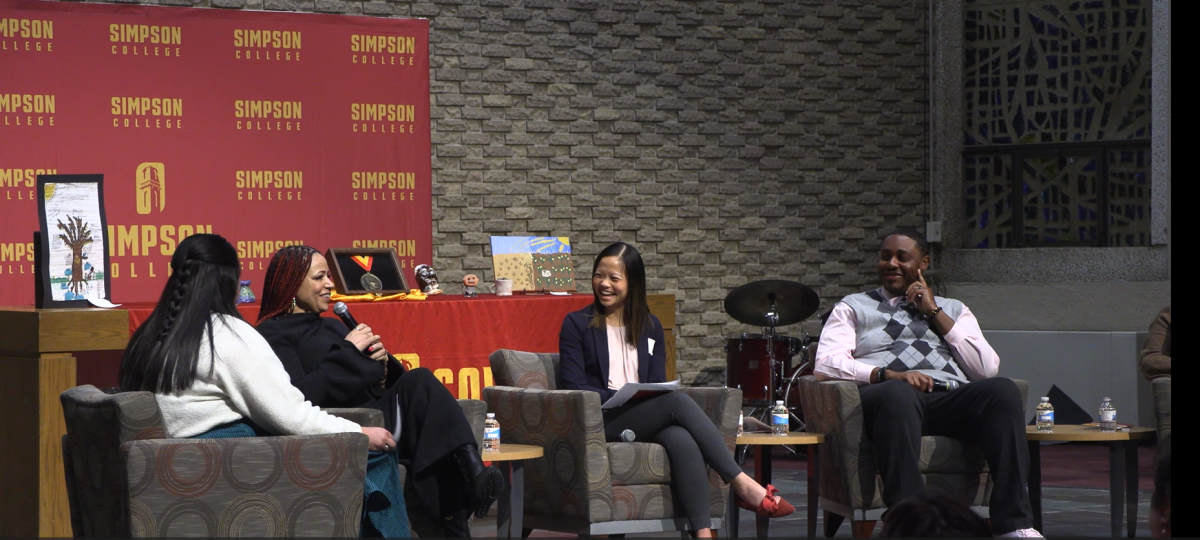
Award-winning journalist Nikole Hannah-Jones was granted the George Washington Carver medal at Simpson College on Jan. 29 and spoke to a large audience about journalism, race and social responsibility.
Since 2008, Simpson has awarded the George Washington Carver medal to an outstanding individual whose life exemplifies the commitment and vision of service of George Washington Carver. Carver, who came to Simpson in 1890, said, “At Simpson the kind of people there made me believe that I was a human being.”
This year’s recipient of the medal, Hannah-Jones, is a reporter for The New York Times Magazine, author of “The 1619 Project” and the winner of many national journalism honors, including an Emmy award and the Pulitzer Prize for commentary.
She also founded the Center for Journalism & Democracy, co-founded the Ida B. Wells Society for Investigative Reporting, holds the Knight Chair in Race and Journalism at Howard University and established The 1619 Freedom School in her hometown of Waterloo, Iowa.
More than 100 students, faculty and community members attended the ceremony. It began with an invocation from College Chaplain, Mara Bailey, and remarks from Simpson students and faculty members. These included Latinos Unidos president Rachel Garcia, Student Body President Jack Campbell and associate professor of computer science Carolyn Brodie.
Garcia, a junior studying mathematics, has been the president of Latinos Unidos for the past two years. Allie Martinez, the director of community and belonging at Simpson, and a member of the Carver celebration planning committee, asked Garcia to read the reflections on the legacy of George Washington Carver.
Garcia expressed her appreciation for being included in the ceremony.
“I think it was really important that Allie was able to bring in myself and the Student Body President to be able to speak, because having students to recognize Nikole Hannah-Jones was very important to show that Simpson is happy she is the one receiving it … and it is not just a faculty thing,” she said.
The ceremony included performances of Bridges 2 Harmony Choir from Roosevelt High School. The choir sang James McNear’s arrangements of the songs, “Oh Mary, Oh Martha,” and “Build a Bridge.”
In addition to the ceremony, a first-time panel discussion was hosted after the award presentation. The panel featured Hannah-Jones, as well as Amy Duncan, the owner of the Indianola Independent Advocate, The Record-Herald and Indianola Tribune, Steffi Lee Dwyer, who works in compliance for the senior living industry and previously worked as a journalist and in immigration law and Ty Rushing, who is an assistant professor of practice at the University of Iowa and president of the Iowa Association of Black Journalists.
As Hannah-Jones spoke of her appreciation for the award, she reflected on her Iowan roots.
“When I got the email that I was receiving this honor, it really meant a lot to me … Growing up in Waterloo, we didn’t have a lot of examples of Black Iowans,” Hannah-Jones said.
Hannah-Jones compared her beliefs to the traditional straight-news expectations of the Associated Press. She described a practice she called “Objectivity and method,” which allows her to be accurate in her reporting, while still telling the truth.
“I think the idea of objectivity in journalism has been used as a shield against criticism,” Hannah-Jones said. “People will say, ‘I’m just recording the facts,’ but we frame the facts.”
Hannah-Jones also spoke about her experience with pushback about Iowa legislation. Iowa “House File 222,” attempted to ban Hannah-Jones’s book, “The 1619 Project,” and “House File 802,” which introduced the idea of “divisive concept” laws, were part of what Hannah-Jones said created barriers for her work.
“Talking about race is absolutely divisive, because race, racism, and racial inequality is divisive,” Hannah-Jones said. “Whether we talk about race or not, it’s having an impact in society.”
Hannah-Jones also commented on people’s perceptions of comfort and why Iowa law would see these challenging topics as divisive. She talked of her difficulties in navigating what it was like growing up Black in a predominantly white, rural area in comparison with the legislators’ views.
“They say, ‘we don’t want to make people uncomfortable.’ Well, my entire K-12 experience was uncomfortable,” Hannah-Jones said. “No one cared about the Black kid who has to sit in a class and be completely erased from the narrative – completely erased from the story.”
Hannah-Jones discussed further what it means to ignore these divisive or uncomfortable topics. She highlighted many other social issues and how legislation and censorship contribute to them.
“It’s actually the wound that’s the problem, not addressing the wound,” Hannah-Jones said.
In addition to her words on these matters, the other panelists, Lee Dwyer, Rushing and Duncan, also spoke about their own experiences with journalism and what it means to them. Moderator Martinez asked each what advice they would give students who want to produce work that challenges and questions the narrative.
“Stay curious,” Lee said. “Just be open to learning more. Journalism is so informative. It’s an educational tool. You have the opportunity to contribute to that.”
Rushing spoke from an instructor’s perspective as a journalism professor at the University of Iowa. He shared what he told his students in the classroom.
“Find the story that’s not being told,” Rushing said. “Find something that excites you and figure out a way that you can tell the story in a broader sense.”
After the panel, the ceremony ended with a final performance by the choir and closing remarks. Afterwards, attendees lined up to take photos, have books signed and thank Hannah-Jones, which concluded this year’s George Washington Carver celebration.